Home Blog Page 21

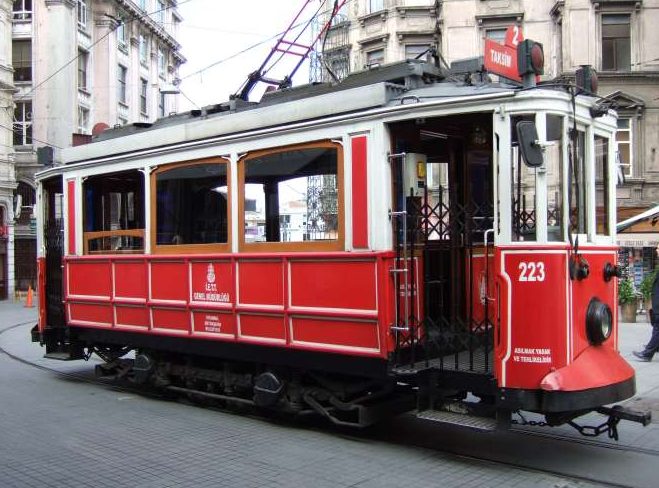
Tram in Istanbul

0

In his book entitled “A Tramway from Dersaadet to Istanbul,” R. Sertag Kayserilioglu tells the story of public transport, beginning in 1871 with the I.E.T.`s (Istanbul Electric Tramway Tunel) horse-drawn tramways. In so doing the book also sheds light upon an important chapter in the urban social history of Istanbul.

Tunel-Sisli becomes the first tramway line

In Istanbul, the excitement had begun. As would have been expected, some infrastructure limitations came to light during the process of converting to electrical tramways. There was great surprise and expectation when lines started to be laid on the new Galata Bridge as in a short time, the first tramway cars would be passing over the bridge. The first line was the Tiinel-Sisli line.

The dates for the other lines being fed electricity was listed in order as follows: 16th August 1913: Tunel- Sisli, 10th January 1914: Karakdy-Besiktas, 12th January 1914: Galatasaray-Galata, 2nd February 1914: Eminonu-Sirkeci, 11th February 1914: Begiktag-Ortakoy, 20th February 1914: Sirkeci-Beyazit, 30th March 1914: Beyazit-Aksaray, 18th May 1914: Sehzadebagi-Fatih, 23rd November 1914: Arnavutkoy – Bebek.

Tramway signs

Until the end of 1928, tramway signs could be seen both in old Turkish and also in some incomprehensible writing style that resembled French phonetics in Turkish. The reason for this was, of course, the large numbers of minorities living in Istanbul, the Levantines and the many foreign tourists. For example: Chichli (Sisli), Eyoub (Eyup) Matchka (Macka), Karakeury (Karakoy), Bechictache (Besiktas).

The same writing style could be seen on tickets and traffic signs. The tramway company executives, ever thoughtful, also had picture symbols of destinations painted on the signs and wagons, so that the illiterate could board the right tramway. For instance, there was a picture of a tower on the Yedikule (“Seven Towers”) tramway and a picture of a cannon ball on the Topkapi (“Cannon`s Gate”) tramway.

The tramway crew

“Without a doubt, the tramway`s most glamorous staff were the driver and the conductor. From time to time, when the inspector joined them, the number of personnel went up to three. The conductor had the most contact with passengers. During the period when it was the rule that tramways were boarded at the rear and exited from the front, the conductor usually stood at the rear door of the wagon and issued tickets to the passengers as they boarded.

In one hand they had a box with two compartments and two lids; inside were different booklets of tickets, depending on the line. Behind their ears they always had a pen, used to mark the point of boarding and the destination. As for the drivers, they drove from inside their own special platform. They were more respected, their uniforms more elaborate. According to the drivers, whose working area was exposed to the elements on two sides, there were three places in Istanbul where they got very cold during winter, Arnavutkoy, the bridge and Saraghane- bagi.

In order not to stay in the cold for too long, the drivers would speed through these areas. “And so this is how R. Ser- tag Kayserilioglu tells the story of over a century of the IETT in his book “A Tramway from Dersaadet to Istanbul.” This book is a handy resource and a fascinating read that you will not want to put down.

Read More about Bulgaria private tours
Istanbul Palaces and Kasirs

0

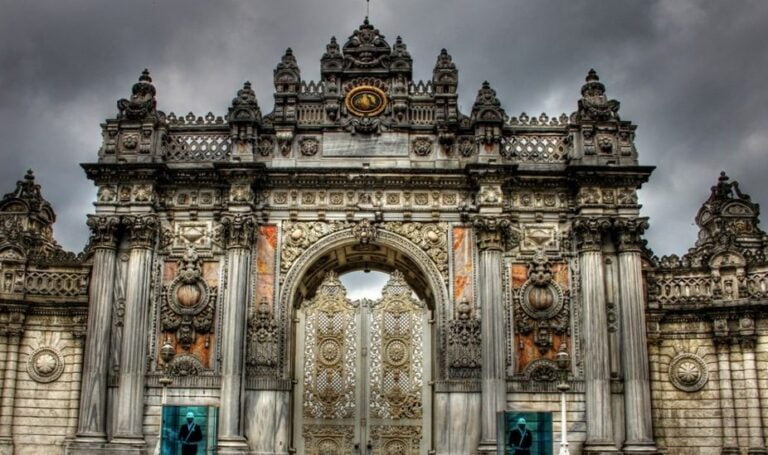
Dolmabahce Palace

Sultan Abdulmecit moved his court from Topkapi Palace to Dolmabahce Palace in 1855.

The palace that was built in showy style called Sekerci Style, is built by the Armenian Balyan family.

It forms a complex with Dolmabahqe Mosque and the Clock Tower. Mustafa Kemal Ataturk, the founder of modern Turkey, died in this palace in 1938. The interior decoration of the palace is in harmony with the complexity of the exterior surface which extends as far as 500 meters parallel to the sea.

(Open between 9 AM -4 PM everyday except Monday and tbursday, Dolmabahce Caddesi (Dolmabahce).

Dolmabahce Palace, constructed in 1855, after Topkapi Palace, is an imposing building on the sea shore.

Aynali Kavak Kasri

Aynali Kavak Kasi, located at the shore of Bosphorus, is a palace decorated with Venetian mirrors. The palace that was built in the 18^ century by the order of Sultan Selim UI and rebuilt in 1830, hosts the cultural activities today. Open between 9.30 AM – 5 PM every day except Monday and Thursday, Kasimpasa Haskoy Yolu (Kasimpasa).

 Kuguksu Kasri

Next to Anadolu Hisan, right at the shore is Kuquksu Kasn with its pretty fountain, from the 19th century.

Open between 9.30 AM – 5 PM everyday except Monday and Thursday, Anadolu Hisan

 Beylerbeyi Kasri

Beylerbeyi Kasi that is located on the Asian side, to the north of the Bosphorus Bridge was a pavilion where the empires and sultans hosted their guests. Its construction was completed in 1865.

Open between 9.30 AM – 5 PM Every day except Monday and Thursday, Beylerbeyi.

Bab-i Ali and Alay Kosku

Bab-i Ali used to have the same impression between r843-i922, what Kremlin has today for the European politicians. Alay Kosku, with its wavy roof and two fountains is across the building that was once the administrative centre of Ottoman Empire.

Alemdar Caddesi (Sultanahmet).

Open between 9.30 AM – 5 PM everyday except Monday and Thursday,

Tekfur Sarayi

As the best palace in terms of condition remained from Byzantium,

Tekfur Sarayi, with its three-floor decorative exterior surface, is dates to the late 13th century with a great possibility.

It was built between the front and main walls of Theodosian Walls.

Open between 9 AM – 12.30 PM and 1.30 PM-5 PM everyday except Monday,

Hoca Sakir/Sishane Caddesi (Ayvansaray).

 Sait Halim Pasha Chalet

Sait Halim Pasa Chalet, which is placed in Yenikoy, is now back to the life after the restoration works that lasted for years. The chalet, which was built as a sea palace by Petraki Adamandidis from Canakkale in the first years of 19th century, is placed in a garden that has a pier and also a gate to Bosphorus. It is also named a “chalet with lions” because of the two lion sculptures that are in the front of the garden called “selamlik”.

Rooms lined up around the middle sofa constitute the main plan of the chalet, rising on the marble basement as two levels. South part and north parts of the chalet are separated for men and women only. The entrance to the both parts is through the glassed-in sections. In spite of the plain exterior of the chalet the interior walls and ceilings are decorated by Arabic influenced ornaments.

Read More about Bulgaria Private Tour

How the Bosphorus was frozen in 1954

0

Curious Eyes

The next day, it`s reported that the wind changed direction and the ices move rather to the shores of Sile and this fact lightens the Bosphorus. After that the ices quit the Bosphorus and it stops snowing, such news cover much lesser place in the newspapers. After the flow of ices, on the first Sunday when a mild weather is felt, the inhabitants of Istanbul rush to the Bosphorus. “Gece Postasi” reports the news as follows:“

The inhabitanst of Istanbul watch the flow of ices covering the Bosphorus at various points and they take photos together with their families. Some tricksters trying to take advantage of this event took possession of some ice fields and they ask for money from people taking photos there.”

The Bosphorus lightened due to the nice weather and the change in the wind direction is again invaded by the ices some days after. The maritime transportation is halted. The newspaper “Istanbul Ekspres” dated March 2, based on the wireless communication of a ship with Roumanian flag, reports that much bigger ice fields arrive towards the Bosphorus. Much fewer news showing the difficulties in winter 1954 appear in the newspapers. We don`t know whether it`s because less ices are seen or the news loses its significance but the last news is reported by the newspaper “AkSam” dated March 5.

“The space between Buyukdere and Kavaklar on the Rumeli and Anatolian shores of the Bosphorus is entirely covered by ice.”

Effects To The Daily Life

Following the freezing cold, snowstorm, storm and heavy snow lasting 10 – 15 days, the Bosphorus is frozen and Istanbul covered in white looks like the North European countries. Compared to the actual cold weathers, the winter 1954 looks much more like the Siberian winter. Cemalettin Bildik writes the following about the ices blocking the Bosphorus in the newspaper “Aksam” dated February 28.1954: “After 1929.

The ice fields arriving from the Danube and other rivers obstructed once again the Black Sea Straits and one can go on foot from the Garipler Village on the Rumeli side to the Poyraz Village on the Anatolian side.” This is the most important event of the winter 1954. It`s even much more important that the shortage of coal and wood and the price of leek jumped to 75 kuruS (piaster) and the price of spinach jumped to 140kuruS.

No matter how quick is the governor in uniting both sides of the Bosphours, the heavy winter managed to make people walk on the Bosphorus and thus, the real problem of food has been forgotten. Not only the private cars but also low-income people coming by bus or dolmus? crowded the Bosphorus to contemplate the ice fields.

Don`t Wake The Moon Up

Yesterday me too, I went to Yenimahalle to see people who contemplate the ice fields. The trip to the Bosphorus in heavy winter recalls the trips made in spring and summer but there is a big difference… Where are ladies in their sleeveless dresses making promenade on the shore… Ladies with shorts… Where are those jumping into the sea from the shores…

We meet some familiar faces but they wear now warm clothes and overcoats. While contemplating this landscape, don`t know why but the Moda Bay comes to my mind. The voice of the master Munir Nurettin Selcuk rings in my ears.“Aheste gek kurekleri, mehtap uyanmasin” (Row slowly, so that the moon doesn`t wake up)… Which moon, master?…Let`s come and look at this state of the Bosphorus and imagine the Moda Bay. Even if the boatman rows slowly, where can he go among these ice fields… Let alone the rowboat, the ship doesn`t sail.”

Read More about Private Istanbul tour for Ethiopia Diplomatic group