Home Blog Page 18

The Book of Ruth 1

0

The Book of Ruth (From the Old Testament)

Into the extremely complicated questions of authorship, origin and development of the Old Testament it is not necessary to enter. Ruth is one of the most beautifully conceived and finely written narratives of all Biblical literature. Although it has its place in the ethical scheme of the Old Testament, it seems to have been written with an artistic zest and freedom from constraint that are rare in the religious literature of any race.

The text used here is that printed in Volume IV of Ancient Hebrew Literature, in Everyman`s Library, published in 1907 by J. M. Dent and Sons, by whose permission it is here included. (The last sentence has been omitted, as it has nothing to do with the story.)

The Book of Ruth

Now it came to pass in the days when the judges ruled, that there was a famine in the land. And a certain man of Beth-lehem- judah went to sojourn in the country of Moab, he, and his wife, and his two sons. And the name of the man was Elimelech, and the name of his wife Naomi, and the name of his two sons Mahlon and Chilion, Ephra- thites of Beth-lehem-judah. And they came into the country of Moab, and continued there.

And Elimelech Naomi`s husband died; and she was left, and her two sons. And they took them wives of the women of Moab; the name of the one was Orpah, and the name of the other Ruth: and they dwelled there about ten years. And Mahlon and Chilion died also both of them; and the woman was left of her two sons and her husband.

Then she arose with her daughters-in-law, that she might return from the country of Moab: for she had heard in the country of Moab how that the Lord had visited His people in giving them bread. Wherefore she went forth out of the place where she was, and her two daughters-in-law with her; and they went on the way to return unto the land of Judah. And Naomi said unto her two daughters-in-law:— “Go, return each to her mother`s house: the Lord deal kindly with you, as ye have dealt with the dead, and with me. The Lord grant you that ye may find rest, each of you in the house of her husband.” Then she kissed them; and they lifted up their voice, and wept. And they said unto her:—“Surely we will return with thee unto thy people.”

And Naomi said:—“Turn again, my daughters: why will ye go with me? are there yet any more sons in my womb, that they may be your husbands? Turn again, my daughters, go your way; for I am too old to have an husband. If I should say, I have hope, if I should have an husband also to-night, and should also bear sons; would ye tarry for them till they were grown? would ye stay for them from having hus-bands? nay, my daughters; for it grieved me much for your sakes that the hand of the Lord is gone out against me.”

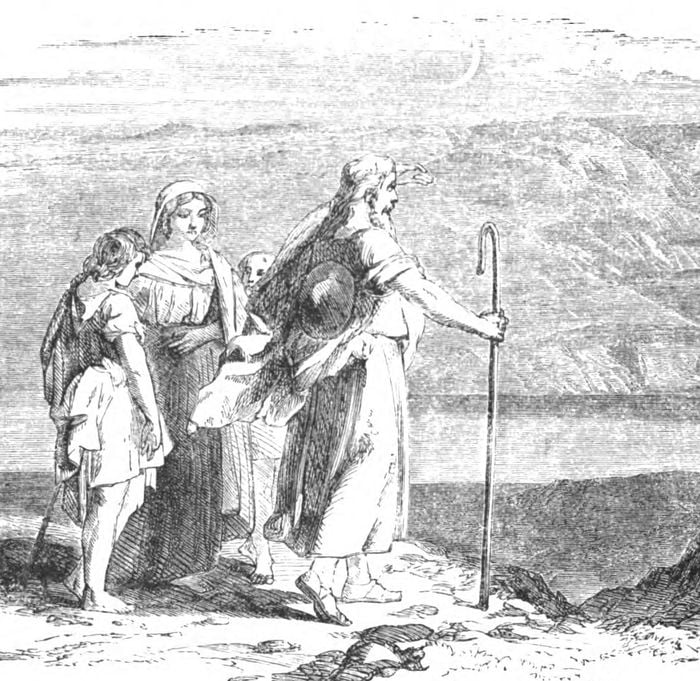
And they lifted up their voice, and wept again: and Orpah kissed her mother-in-law; but Ruth clave unto her. And she said:—“Behold, thy sister-in-law is gone back unto her people, and unto her gods: return thou after thy sister-in-law.” And Ruth said:—“Intreat me not to leave thee, or to return from following after thee: for whither thou goest, I will go; and where thou lodgest, I will lodge: thy people shall be my people, and thy God my God: where thou diest, will I die, and there will I be buried: the Lord do so to me, and more also, if ought but death part thee and me.”

Beth-lehem

When she saw that she was steadfastly minded to go with her, then she left speaking unto her. So they two went until they came to Beth-lehem. And it came to pass, when they were come to Beth-lehem, that all the city was moved about them, and they said:—“Is this Naomi?” And she said unto them:—“Call me not Naomi, call me Mara: for the Almighty hath dealt very bitterly with me. I went out full, and the Lord hath brought me home again empty: why then call ye me Naomi, seeing the Lord hath testified against me, and the Almighty hath afflicted me?”

So Naomi returned, and Ruth the Moabitess, her daughter-in-law, with her, which returned out of the country of Moab: and they came to Beth-lehem in the beginning of barley harvest. And Naomi had a kins-man of her husband`s, a mighty man of wealth, of the family of Eli- melech; and his name was Boaz. And Ruth the Moabitess said unto Naomi:—“Let me now go to the field, and glean ears of corn after him in whose sight I shall find grace.” And she said unto her:—“Go, my daughter.” And she went, and came, and gleaned in the field after the reapers: and her hap was to light on a part of the field belonging unto Boaz, who was of the kindred of Elimelech.

And, behold, Boaz came from Beth-lehem, and said unto the reapers: —“The Lord be with you.” And they answered him’:—“The Lord bless thee.” Then said Boaz unto his servant that was set over the reapers: —“Whose damsel is this?” And the servant that was set over the reapers answered add said:—“It is the Moabitish damsel that came back with Naomi out of the country of Moab: and she said, I pray you, let me glean and gather after the reapers among the sheaves: so she came, and hath continued even from the morning until now, that she tarried a little in the house.” Then said Boaz unto Ruth:—“Hearest thou not, my daughter?

Go not to glean in another field, neither go from hence, but abide here fast by my maidens: let thine eyes be on the field that they do reap, and go thou after them: have I not charged the young men that they shall not touch thee? and when thou art athirst, go unto the vessels, and drink of that which the young men have drawn.” Then she fell on her face, and bowed herself to the ground, and said u ti to him: —“Why have I found grace in thine eyes, that thou shouldest take knowledge of me, seeing I am a stranger?” And Boaz answered and said unto her:—“It hath fully been shewed me, all that thou hast done unto thy mother-in-law since the death of thine husband: and how thou hast left thy father and thy mother, and the land of thy nativity, and art come unto a people which thou knewest not heretofore. The Lord recompense thy work, and a full reward be given thee of the Lord God of Israel, under whose wings thou art come to trust.”

Handmaidens

Then she said:—“Let me find favor in thy sight, my lord; for that thou hast comforted me, and for that thou has spoken friendly unto thine handmaid, though I be not like unto one of thine handmaidens.” And Boaz said unto her:—“At mealtime come thou hither, and eat of the bread, and dip thy morsel in the vinegar.” And she sat beside the reapers: and he reached her parched corn, and she did eat, and was sufficed, and left. And when she was risen up to glean, Boaz commanded his young men, saying:—“Let her glean even among the sheaves, and reproach her not: and let fall also some of the handfuls of purpose for her, and leave them, that she may glean them, and rebuke her not.”

So she gleaned in the field until even, and beat out that she had gleaned: and it was about an ephah of barley. And she took it up, and went into the city: and her mother-in-law saw what she had gleaned: and she brought forth, and gave to her that she had reserved after she was sufficed. And her mother-in-law said unto her:—“Where hast thou gleaned to-day? and where wroughtest thou? blessed be he that did take knowledge of thee.” And she shewed her mother-in-law with whom she had wrought, and said:—“The man`s name with whom I wrought to-day is Boaz.” And Naomi said unto her daughter-in-law: -“Blessed be he of the Lord, who hath not left off His kindness to the living and to the dead.” And Naomi said unto her:—“The man is near of kin unto us, one of our next; kinsmen.” And Ruth the Moabitess said:

“He said unto me also, Thou shah keep fast by my young men, until they have ended all my harvest.” And Naomi said unto Ruth her daughter-in-law: “It is good, my daughter, that thou go out with his maidens, that they meet thee not in any other field.” So she kept fast by the maidens of Boaz to glean unto the end of barley harvest and of wheat harvest; and dwelt with her mother-in-law.

The above text has been copied from www.doholidays.com; For the rest of the story you can visit link The Book of Ruth.

Read More about Eumieus` Tale 2

Rabbi Akiva 1

0

The Talmud is a great collection of law, ritual, precept, and example, which was composed during the period extending from the First Century B.C. to the Fourth Century A.D. The work was the result of a vast amount of compilation begun, so far as the actual writing is concerned, in the year 219 A.D. by Rabbi Jehudah Hanassi. About the year 500 A.D. it was complete, having been combined with a good deal of material brought together since the first parts were written down. The colossal work is interspersed throughout with parables, like Rabbi Akiva and The Jewish Mother, all of which were used for purposes of illustration.
The texts of these stories are based, by the editors, upon two early translations. There are no titles to the stories in the original.

Rabbi Akiva

The Rabbis tell us that once the Roman Government made a decree forbidding Israel to study the law. Thereupon Pappus, son of Yehudah, one day found Rabbi Akiva teaching it openly to many whom he had gathered round him to hear it. “Akiva,” he said, “dost not thou fear the Government?” “Listen, was the reply, and I will tell thee how it is through a parable. It is the same with me as with the fishes which a fox, walking by a river s bank, saw darting distractedly to and fro in the stream; and, speaking to them, inquired, `From what, pray, are ye fleeing?` `From the nets,` they answered, `which the sons of men have set to snare us. Why, then, rejoined the fox, `not try the dry land with me, where we can live together, as our fathers managed to live before us?`

`Surely,` they exclaimed, thou art not he of whom we have heard as the most cunning of animals; for in this thing thou art not wise, but foolish. For if we have cause to fear where it is natural for us to live, how much more reason have we to do so where we must die!` Exactly so,” continued Akiva, “is it with us who study the law, in which it is written, `He is thy life and the length of thy days; for if we suffer while studying the law, how much more shah we suffer if we neglect it?”

The story has been taken from www.ensartourguide.com. Whole story can be read on link Rabbi Akiva.

Read More about The Friar of Novara part 3

Horatius at the Bridge 1

0

Ancient Rome

It is a commonplace of literary history that Roman art was largely imitated or derived from the Greek, and in particular that Roman literature contributed little to the world`s store of masterpieces. Yet among the Romans the short story was esteemed more highly and was often more skillfully developed than it was among the Greeks.

The first of the stories chosen is from the historian Livy. Before his day there is very little material from which to select, although if the earlier writers of epic and history were better known to us, we might have found stories in the works of Livius Andronicus, Ennius, and the historians, most of whose writings have been lost. In the Letters of Cicero are numerous incidents falling within our category, but none of them of sufficient intrinsic interest to warrant their inclusion in this volume. Livy`s History abounds in episodes, many of them related with a certain matter-of-factness that characterizes a great deal of Latin prose writing. Still, Horatius at the Bridge is a stirring tale rendered doubly effective by its simplicity.

Ovid was a born teller of stories, and though he borrowed largely from the Greeks and was a fastidious poet intent upon achieving a refined and elegant style, the numerous myths which he treats at length in his Metamorphoses include half a dozen of the loveliest stories ever written.
Other poets and historians and miscellaneous writers—Valerius Maximus, Varro, Statius, Tacitus and Suetonius—tried their hand at story-telling, and even Vergil in his JEneid recounted episodes that are genuine stories, but none of them could rival the technical skill with which the minor poet Phaedrus turned the ffssopian fables and everyday incidents of life and history into graceful and appealing tales. Like the earlier fabulists, Phaedrus preached litde sermons. The most interesting parts of his work are the little anecdotes, like the one included in this volume; these are miniature stories. The other famous Roman fabulist was Avianus who, rediscovered in the Middle Ages, exerted a profound and lasting influence in France and Germany. But his work is neither so finished nor so attractive as that of Phaedrus.

Many genuine stories are found in the personal correspondence of the time, chiefly among the published collections of Cicero and Pliny the Younger. Pliny wrote several short stories which he elaborated with conscious skill, for he wrote with a view to publication. Throughout all modern literature we find stories, indeed lengthy stories (see Richardson), related through the medium of letters. This is a deliberate device employed to lend to the narrative an air of actuality. It would be enlightening to know whether Pliny wrote his Haunted House as a literary experiment, or whether he really believed the story. But supposing he related it as a fact—supposing even that all the facts were to be proved scientifically correct, would it be any the less a good story?
Matron of Ephesus

Petronius belonged to a different world in which Latin prose had lost a good deal of its rigid dignity, and like the literature of the late Hellenistic period in Greece, was characterized by a facile cynicism on the part of the writers, and an over-luxuriance of style. The writers were very numerous, poets, historians, satirists, and even scientists interspersing their writings with tales of haunted houses, ghosts, and all the supernatural apparitions that are the stock-in-trade of the story- writer. Petronius and Apuleius, however, stood head and shoulders above the rest of their contemporaries and followers. The Matron of Ephesus, hackneyed though its theme may be, is a masterpiece of satirical fiction, while The Dream is one of a dozen tales of mystery and imagination which constitute the chief glory of The Golden Ass. That rambling romance, it will be remembered, also contains the enchanting Cupid and Psyche, which is far too long for inclusion in a collection of this sort.

Just at what point Roman literature ended is a matter to be determined by the historians, but after the Fifth Century A.D. it becomes increasingly difficult to designate any tale as unmistakably Roman.

Then foreigners began to change the face of the Empire, Christianity damped the ardour of the artist and stifled the imagination of the storyteller. It is not until the dawn of modern times, some six or seven centuries afterward, when the fragments of Roman stories were again taken up and imbedded in the curious mediaeval mosaics of the Gesta Romanorum and the Hundred Ancient Tales, that we realize that the art of tale-telling had never been forgotten.

Throughout the break-up of Rome and the barbarian invasions, through the darkest years of the Tenth Century, the Latin traditions were preserved in the manuscripts of the monasteries, and on the lips of singers, minstrels, acrobats, and actors.

With Apuleius and Petronius the short story, as a literary-form, achieved a decided technical advance over the efforts of the Greeks. With these later writers the story was told largely for its own sake, and not to illustrate a moral truth or glorify the deeds of the Roman people.

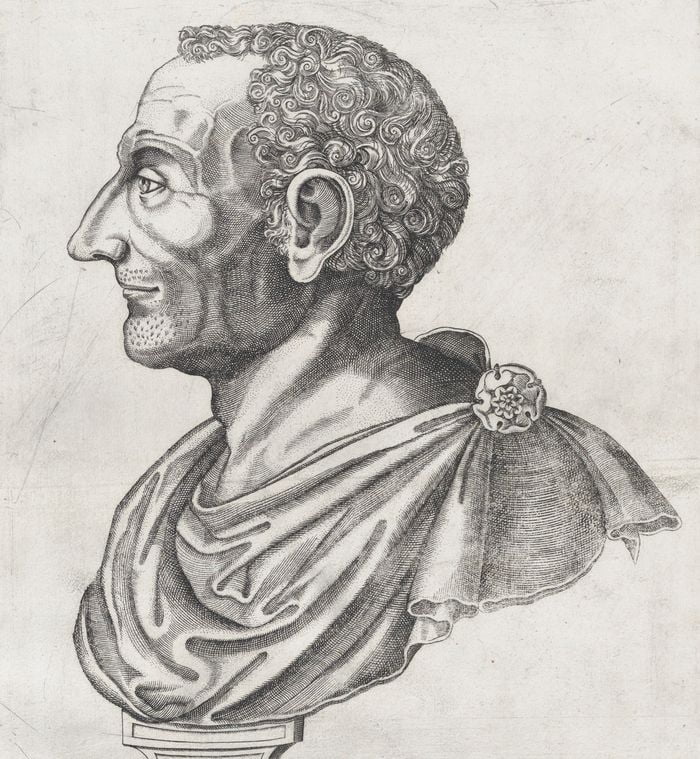
Livy (59 B.C.-I7 A.D.)

Titus Livius, known to us under the English title of Livy, though born in the provinces at Padua, spent most of his life at the capital, where he was a teacher and writer of history. His History of Rome was a monumental work, of which only a part has come down to us. Like practically all the historians of antiquity (and most of the modems, for that matter) he introduces stories and anecdotes on hearsay evidence, using them in order to glorify his country or to drive home a lesson. Horatius at the Bridge is a case in question, and though it may be founded on fact, it is probably apocryphal in detail.

The present translation (including Chapters IX and X of Book II) is a revision of that made by D. Spillan, published in the Bohn edition in 1872. There is no title in the original.

The above text has been copied from docappadocia.com; For the rest of the story you can visit link Horatius at the Bridge.

Read More about Taste of Balkan Tour

Phineus And The Harpies 2

0

Thus he spake; and towards him the aged sire opened his sightless eyes and lifted them up and replied with these words:

“Be silent, store not up such thoughts in thy heart, my child. Let the son of Leto be my witness, he who of his gracious will taught me the lore of prophecy, and be witness the ill-starred doom which possesses me, and this dark cloud upon my eyes, and the gods of the underworld —and may their curse be upon me if I die perjured thus—no wrath of heaven will fall upon you two for your help to me.”

Flash lightning

Then were those two eager to help him because of the oath. And quickly the younger heroes prepared a feast for the aged man, a last prey for the Harpies; and both stood near him, to smite with the sword those pests when they swooped down. Scarcely had the aged man touched the food when they forthwith, like bitter blasts or flashes of lightning, suddenly darted from the clouds, and swooped down with a yell, fiercely craving for food; and the heroes beheld them and shouted in the midst of their onrush. But they, at the cry, devoured everything and sped away over the sea afar, and an intolerable stench remained. And behind them the two sons of Boreas, raising their swords, rushed in pursuit.

For Zeus imparted to them tireless strength; but without Zeus they could not have followed, for the Harpies used ever to outstrip the blasts of the west wind when they came to Phineus, and when they left him. And, as when, upon the mountain-side, hounds, cunning in the chase, run in the track of horned goats or deer, and as they strain a little behind, gnash their teeth upon the edge of their teeth in vain; so Zetes and Calias rushing very near, just grazed the Harpies in vain with their fingertips.
And assuredly they would have torn them to pieces despite heaven`s will when they had overtaken them far off at the Floating Islands, had not swift Iris seen them and leaped down from the sky from heaven above and checked them with these words: “It is not lawful, O sons of Boreas, to strike with your swords the Harpies, the hounds of mighty Zeus; but I myself will give you a pledge, that hereafter they shall not draw near to Phineus.”

With these words she took an oath by the water of Styx, which to all the gods is most dread and most awful, that the Harpies would never thereafter again approach the home of Phineus, son of Agenor, for so it was fated. And the heroes, yielding to the oath, turned back their flight to the ship. And, on account of this, men called them the Islands of Turning, though aforetime they had called them the Floating Islands. And the Harpies and Iris parted. They entered their den in Minoan Crete; but she sped up to Olympus, soaring aloft on her swift wings.

Meantime the chiefs carefully cleansed the old man`s squalid skin, and, with due selection, sacrificed sheep which they had borne away from the spoil of Amycus. And when they had laid a huge supper in the hall, they sat down and feasted, and with them feasted Phineus ravenously, delighting his soul as in a dream. And there, when they had taken their fill of food and drink, they kept awake all night, waiting for the sons of Boreas. And the aged sire himself sat in the midst, near the hearth, telling of the end of their voyage and the completion of their journey.

For the rest of the story you can visit link Phineus and the Harpies.

Read More about The District Doctor part 9

Eumieus` Tale 2

0

The story below has been copied from docappadocia.com. You can read the rest of the story on  Eumieus Tale.

Homer (About 1000 B.C.)

The first mention of Homer dates from the Seventh Century B.C., but when he lived, or indeed whether he ever lived at all, are questions that have never been solved. The Iliad and The Odyssey were probably composed about a thousand years before the Christian era. The short story, as we know it, was not of course a recognized literary form, but Eumtsus ` Tale, in The Odyssey, happens to be an excellent example. It is told to Odysseus by the old swine-herd.

The present version, purposely reduced by the editors to more or less colloquial prose, is based upon three translations. There is no title in the original.

Eumieus` Tale

There is an island over beyond Ortygia—perchance thou hast -L heard tell of it—where the sun turns. It is a goodly island, though not very vast, with rich herds and flocks, and much grain and wine. There is no dearth, and no illness visits poor mortals. When men grow old there, Apollo of the Silverow, in company with Artemis, comes to them and kills them gendy with his shafts. On the island are two cities, which divide all the land between them. My father was king over all, Ctesius son of Ormenus, a godlike man.

“To this land came the Phoenicians, famous sailors greedy for mer-chandise, bringing many things in their dark ship. There was in my father`s palace a Phoenician woman, tall and lovely, and skilful in making beautiful things with her hands; her the Phoenicians deceived by their guile. As she was washing clothes near the hollow ship, one of them conquered her; love beguiles many women, even the noblest. The Phoenician asked her who she was and from what land, and she straight-way showed him the high palace of my father, and said, `I come from Sidon, rich in bronze, and am the daughter of the wealthy Arybas. The Taphians, who are pirates, seized me as I was coming from the fields, brought me to this land, and sold me for a great price to my present master.` Then he who had conquered her said in answer, `Wouldst thou return once more to thy home with us, to see again the high palace of thy father, and see thy mother? They are yet alive, and are reputed to be wealthy.`

“Then the woman made answer to him and said, `This may be, if you sailors will swear to bring me home safely.` Thus she answered, and the sailors swore as she bade them, and after they had sworn, the woman spake to them: `Say naught now; let none of you speak to me when you see me in the street, or even by the well, lest it be known and told to the old man here, and he suspect me and tie me fast and bring death to you all. But keep in mind the plan, and hasten to bring your freight for the homeward voyage. When your ship is full laden, send a messenger quickly to the palace for me, and I will bring gold, all I can lay hand upon. And there is more, besides, that I would bring with me: I am nursing a child for my master, a darling boy who runs about with me; I would bring him with me on the ship. He should bring a high price, if you sell him among men of other lands and other speech.`

“Then she departed to the fair halls. But the sailors remained among us a whole year, and gathered great wealth for their hollow ship, and when it was laden and ready to sail, a messenger was sent to tell the woman. A crafty man with a golden and amber chain came to the halls of my father. My mother and the maidens in the palace were looking upon the chain and holding it, offering the man a price for it, while he made signs in silence to the woman. Then he betook himself to the hollow ship. The woman then took me by the hand and led me out of the house. At the doorway she found the cups and tables of the guests who had feasted and waited upon my father: they had gone out to the meeting-place where councils were held.

And the woman concealed three cups in her bosom, and carried them away, while I followed her innocently. The sun sank and darkness came. Going quickly, we reached the harbor and the swift ship of the Phoenicians; the sailors went aboard, taking us with them, and sailed over the ocean, Zeus giving us favoring winds. We sailed continuously day and night for six days, but when Zeus, son of Cronos, brought the seventh, Artemis the huntress struck down the woman and she fell like a swallow to the bottom of the ship. The sailors threw her overboard, to the seals and the fishes, and I sorrowed. With the help of wind and wave they came to Ithaca, where Laertes bought me. It was thus that I first beheld this place.”

Read More about Maese Pfirez the Organist part 7

The District Doctor part 9

0

Well, I spent the whole night with her in this way. Before morning I went away, feeling as though I were mad. When I went again into her room it was daytime, after morning tea. Good God! I could scarcely recognize her; people are laid in their grave looking better than that. I swear to you, on my honor, I don`t understand I absolutely don`t understand now, how I lived through that experience. Three days and nights my patient still lingered on. And what nights! What things she said to me!

Little hope

And on the last night only imagine to yourself I was sitting near her, and kept praying to God for one thing only: `Take her,` I said, `quickly, and me with her.` Suddenly the old mother comes unexpectedly into the room. I had already the evening before told her the mother there was little hope, and it would be well to send for a priest. When the sick girl saw her mother she said: `It`s very well you have come; look at us, we love one another we have given each other our word.`

`What does she say, doctor? what does she say?` I turned livid. `She is wandering,` I say; `the fever.` But she: `Hush, hush; you told me something quite different just now, and have taken my ring. Why do you pretend? My mother is good she will forgive she will understand and I am dying. … I have no need to tell lies; give me your hand.` I jumped up and ran out of the room. The old lady, of course, guessed how it was.

“I will not, however, weary you any longer, and to me too, of course, it`s painful to recall all this. My patient passed away the next day. God rest her soul!” the doctor added, speaking quickly and with a sigh. “Before her death she asked her family to go out and leave me alone with her.”
“`Forgive me,` she said; `I am perhaps to blame towards you… my illness… but believe me, I have loved no one more than you … do not forget me… keep my ring.` ”

The doctor turned away; I took his hand.

“Ah!” he said, “let us talk of something else, or would you care to play preference for a small stake? It is not for people like me to give way to exalted emotions. There`s only one thing for me to think of; how to keep the children from crying and the wife from scolding. Since then, you know, I have had time to enter into lawful wedlock, as they say. … Oh … I took a merchant`s daughter seven thousand for her dowry. Her name`s Akulina; it goes well with Trifon. She is an ill- tempered woman, I must tell you, but luckily she`s asleep all day. …Well, shall it be preference?”

We sat down to preference for halfpenny points. Trifon Ivanich won two rubles and a half from me, and went home late, well pleased with his success.

Read More about The Secret History part 66

The District Doctor part 8

0

She did not speak; her fingers trembled in my hair; I listen; she is weeping. I began to soothe her, to assure 1 her. … I really don`t know what I did say to her. `You will wake up ! the girl,` I say to her; `Aleksandra Andreyevna, I thank you …’believe me … calm yourself.` `Enough, enough!` she persisted; `never mind all of them; let them wake, then; let them come in it does not matter; I am dying, you see. … And what do you fear? why are you afraid? Lift up your head. … Or, perhaps, you don`t love me; perhaps I am wrong. … In that case, forgive me.`

Aleksandra Andreyevna

`Aleksandra Andreyevna, what are you saying! … I love you, Aleksandra Andreyevna.` She t looked straight into my eyes, and opened her arms wide. `Then take me in your arms.` I tell you frankly, I don`t know how it was I did not go mad that night. I feel that my patient is killing herself; I see that she I; is not fully herself; I understand, too, that if she did not consider herself on the point of death, she would never have thought of me; and, in-deed, say what you will, it`s hard to die at twenty without having known love; this was what was torturing her; this was why, in despair, she caught at me do you understand now?

But she held me in her arms, and would not let me go. `Have pity on me, Aleksandra Andreyevna, and have pity on yourself,` I say. `Why,` she says; `what is there to think of? You know I must die. …` This she repeated incessantly. … `If I knew that I should return to life, and be a proper young lady again, I should be ashamed … of course, ashamed … but why now?` ‘But who has said you will die?` `Oh, no, leave off! you will not deceive me; you don`t know how to he look at your face. …` `You shall live, Aleksandra Andreyevna; I will cure you; we will ask your mother`s blessing … we will be united we will be happy.`

`No, no, I have your word; I must die … you have promised me … you have told me. …` It was cruel for me cruel for many reasons. And see what trifling things can do sometimes; it seems nothing at all, but it`s painful. It occurred to her to ask me, what is my name; not my surname, but my first name. I must needs be so unlucky as to be called Trifon. Yes, indeed; Trifon Ivanich. Every one in the house called me doctor. However, there`s no help for it. I say, `Trifon, madam.` She frowned, Hhook her head, and muttered something in French ah, something unpleasant, of course! and then she laughed disagreeably too.

Read More about The Secret History part 31

The District Doctor part 7

0

The maid was sitting there too, and snoring away in full swing; I can`t find fault with the poor girl, though; she was worn out too. Aleksandra Andreyevna had felt very unwell all the evening; she was very feverish. Until midnight she kept tossing about; at last she seemed to fall asleep; at least, she lay still without stirring. The lamp was burning in the corner before the holy image.

Aleksandra Andreyevna

I sat there, you know, with my head bent; I even dozed a little. Suddenly it seemed as though some one touched me in the side; I turned round. … Good God! Aleksandra Andreyevna was gazing with intent eyes at me … her lips parted, her cheeks seemed burning. `What is it?` `Doctor, shall I die?` `Merciful Heavens!` `No, doctor, no; please don`t tell me I shall live … don`t say so. … If you knew. … Listen! for God`s sake don`t conceal my real position,` and her breath came so fast.

`If I can know for certain that I must die … then I will tell you all all!` `Aleksandra Andreyevna, I beg!` `Listen; I have not been asleep at all … I have been looking at you a long while. … For God`s sake! … I believe in you; you are a good man, an honest man; I entreat you by all that is sacred in the world tell me the truth! If you knew how important it is for me. … Doctor, for God`s sake tell me. … Am I in danger?` `What can I tell you, Aleksandra Andreyevna, pray?` `For God`s sake, I beseech you!`

`I can`t disguise from you,` I say, `Aleksandra Andreyevna; you are certainly in danger; but God is merciful.` `I shall die, I shall die.` And it seemed as though she were pleased, her face grew so bright; I was alarmed. `Don`t be afraid, don`t be afraid! I am not frightened of death at all.` She suddenly sat up and leaned on her elbow. `Now … yes, now I can tell you that I thank you with my whole heart … that s you are kind and good that I love you!` I stare at her, like one pos- i sessed; it was terrible for me, you know. `Do you hear, I love you!`

I `Aleksandra Andreyevna, how have I deserved ` `No, no, you don`t you don`t understand me.` … And suddenly she stretched out her arms, and taking my head in her hands, she kissed it. … Believe ‘ me, I almost screamed aloud. … I threw myself on my knees, and buried my head in the pillow.

Read More about The Secret History part 67

The District Doctor part 6

0

I, too, on my side assure them that it`s nothing, but meantime my heart sinks into my boots. To add to our troubles, the roads were in such a state that the coachman was gone, for whole days together to get medicine. And I never left the patient`s room; I could not tear myself away; I tell her amusing stories, you know, and play Curds with her. I watch by her side at night. The old mother thanks me with tears in her eyes; but I think to myself, `I don`t deserve your gratitude.` I frankly confess to you there is no object in concealing it now I was in love with my patient. And Aleksandra Andreyevna hud grown fond of me; she would not sometimes let any one be in her mom but me.

Forbid her resolutely

She began to talk to me, to ask me questions; where I hud studied, how I lived, who are my people, whom I go to see. I feel that she ought not to talk; but to forbid her to to forbid her resolutely, you know I could not. Sometimes I held my head in my hands, and nuked myself, `What are you doing, villain?` … And she would take my hand and hold it, give me a long, long look, and turn away, sigh, Mtd say, `How good you are!` Her hands were so feverish, her eyes so lnrge and languid. … `Yes,` she says, `you are a good, kind man; you are not like our neighbors.

No, you are not like that. … Why did I not know you till now!` `Aleksandra Andreyevna, calm yourself,` I say. … `I feel, believe me, I don`t know how I have gained … but there, calm yourself. … All will be right; you will be well again.` And meanwhile I must tell you,” continued the doctor, bending forward and raising his eyebrows, “that they associated very little with the neighbors, because the smaller people were not on their level, and pride hindered them from being friendly with the rich. I tell you, they were an exceptionally cultivated family; so you know it was gratifying for me.

She would only take her medicine from my hands… she would lift herself up, poor girl, with my aid, take it, and gaze at me. … My heart felt as if it were bursting. And meanwhile she was growing worse and worse, worse and worse, all the time; she will die, I think to myself; she must die. Believe me, I would sooner have gone to the grave myself; and here were her mother and sisters watching me, looking into my eyes… and their faith in me was wearing away. `Well? how is she?` `Oh, all right, all right!` All right, indeed! My mind was failing me. Well, I was sitting one night alone again by my patient.

Read More about A Letter and a Paragraph part 6

The District Doctor part 5

0

But God Almighty did not make me a fool; I don`t take black for white; I know a thing or two; I could see very clearly, for instance, that Aleksandra Andreyevna that was her name did not feel love for me, but had a friendly, so to say, inclination a respect or something for me. Though she herself perhaps mistook this sentiment, anyway this was her attitude; you may form your own judgment of it. But,” added the doctor, who had brought out all these disconnected sentences without taking breath, and with obvious embarrassment, “I seem to be wandering rather you won`t understand anything like this…. There, with your leave, I will relate it all in order.”

He drank off a glass of tea, and began in a calmer voice.

Belief in himself

“Well, then. My patient kept getting worse and worse. You are not a doctor, my good sir; you cannot understand what passes in a poor fellow`s heart, especially at first, when he begins to suspect that the disease is getting the upper hand of him. What becomes of his belief in himself? You suddenly grow so timid; it`s indescribable. You fancy then that you have forgotten everything you knew, and that the patient has no faith in you, and that other people begin to notice how distracted you are, and tell you the symptoms with reluctance; that they are looking at you suspiciously, whispering.

Ah! it`s .horrid! There must be a remedy, you think, for this disease, if one could find it. Isn`t this it? You try no, that`s not it! You don`t allow the medicine the necessary time to do good. … You clutch at one thing, then at another. Sometimes you take up a book of medical prescriptions here it is, you think!

Sometimes, by Jove, you pick one out by chance, thinking to leave it to fate But meantime a fellow-creature`s dying, and another doctor would have saved him. `We must have a consultation,` you say; `I will not take the responsibility on myself.` And what a fool you look at such times! Well, in time you learn to bear it; it`s nothing to you. A man has died but it`s not your fault; you treated him by the rules. But what`s still more torture to you is to see blind faith in you, and to feel yourself that you are not able to be of use. Well, it was just this blind faith that the whole of Aleksandra Andre- ycvna`s family had in me; they had forgotten to think that their daughter was in danger.

Read More about The Secret History part 75